Introduction to Aliqeyr Mohamed Nur's "Dhibkii Dheef Baa Ka Dambaysay"
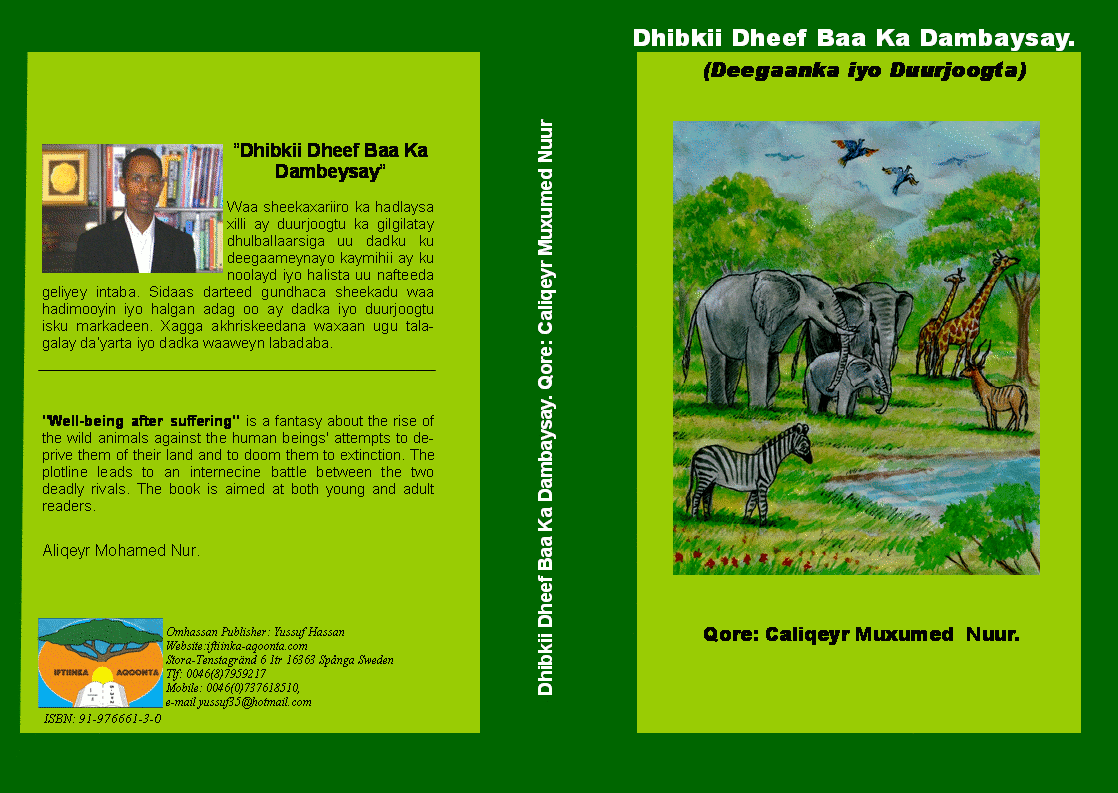
Kapchits’s introduction to the book Dhibkii Dheef Baa Ka Dambaysay («Well-being after suffering») by the Somali writer Aliqeyr Mohamed Nur — Caliqeyr Muxumed Nuur in Somali orthography. Published by Omhassan Publisher, Spånga, Sweden; ISBN 91-976661-3-0.
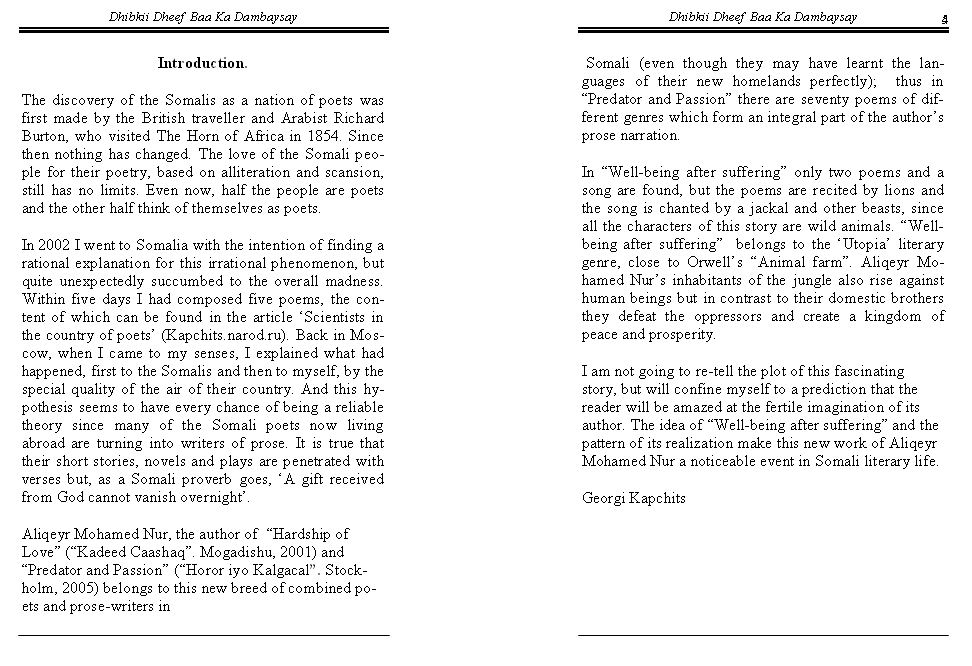
On the old site this introduction existed only as a scanned image, which means it could not be read by search engines, quoted or cited. It is transcribed here from that scan, which is reproduced below. The text carries no date of its own; the scanned file dates from February 2014.
Introduction
The discovery of the Somalis as a nation of poets was first made by the British traveller and Arabist Richard Burton, who visited The Horn of Africa in 1854. Since then nothing has changed. The love of the Somali people for their poetry, based on alliteration and scansion, still has no limits. Even now, half the people are poets and the other half think of themselves as poets.
In 2002 I went to Somalia with the intention of finding a rational explanation for this irrational phenomenon, but quite unexpectedly succumbed to the overall madness. Within five days I had composed five poems, the content of which can be found in the article ‘Scientists in the country of poets’ (Kapchits.narod.ru). Back in Moscow, when I came to my senses, I explained what had happened, first to the Somalis and then to myself, by the special quality of the air of their country. And this hypothesis seems to have every chance of being a reliable theory since many of the Somali poets now living abroad are turning into writers of prose. It is true that their short stories, novels and plays are penetrated with verses but, as a Somali proverb goes, ‘A gift received from God cannot vanish overnight’.
Aliqeyr Mohamed Nur, the author of “Hardship of Love” (“Kadeed Caashaq”. Mogadishu, 2001) and “Predator and Passion” (“Horor iyo Kalgacal”. Stockholm, 2005) belongs to this new breed of combined poets and prose-writers in Somali (even though they may have learnt the languages of their new homelands perfectly); thus in “Predator and Passion” there are seventy poems of different genres which form an integral part of the author’s prose narration.
In “Well-being after suffering” only two poems and a song are found, but the poems are recited by lions and the song is chanted by a jackal and other beasts, since all the characters of this story are wild animals. “Well-being after suffering” belongs to the ‘Utopia’ literary genre, close to Orwell’s “Animal farm”. Aliqeyr Mohamed Nur’s inhabitants of the jungle also rise against human beings but in contrast to their domestic brothers they defeat the oppressors and create a kingdom of peace and prosperity.
I am not going to re-tell the plot of this fascinating story, but will confine myself to a prediction that the reader will be amazed at the fertile imagination of its author. The idea of “Well-being after suffering” and the pattern of its realization make this new work of Aliqeyr Mohamed Nur a noticeable event in Somali literary life.
Georgi Kapchits
A note on the reference
The text above is given exactly as it stands in the book. Two details in it do not match the article it points to, and the discrepancy is left in place rather than corrected, since the introduction is the author’s own text.
‘Scholars in the Country of Poets’ — the essay of that title on kapchits.narod.ru, and the only one there — is subtitled Notes on the 8th International Congress of Somali Studies (Hargeisa, July 3–13, 2001), not 2002; and in it the author writes that he composed three poems, not five. The introduction was written some thirteen years later.
The essay is worth opening for a second reason. It ends on the same folktale that Kapchits retells in the second WardheerNews interview: a nomad, offered either five gifts or to be spoken of in five places, chooses the five places. In 2001 Kapchits promised the hosts of the Congress that he would speak of their hospitality in five places, and the essay is the first of them. In 2006, thanking the journalist whose interview brought him thousands of letters, he returned to the story — this time to say that he had been spoken of in five hundred places.
The source
The book is by Aliqeyr Mohamed Nur, not by G. L. Kapchits; only the introduction is his. Rights in the book belong to its author and publisher.