Dr. Georgi L. Kapchits
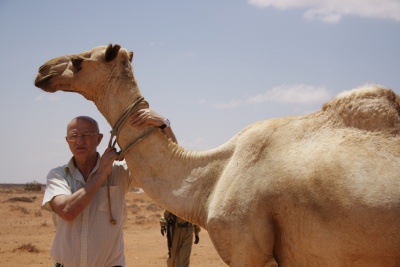
Autobiography
I was born in 1939 in the Belarusian town of Osipovichi, where my father, a Red Army officer, was stationed at the time. I graduated from secondary school in 1956 in the Ukrainian city of Striy, in the Lvov region. Subsequently, I worked as an electric welder at the local railcar manufacturing plant and completed my active military service in the Southern Urals, in the city of Chebarkul.
I was demobilized in the spring of 1961, and that autumn I enrolled in the Faculty of Oriental Studies at Leningrad University. There, I began learning Amharic, though I achieved true proficiency at the Institute of Oriental Languages at Lomonosov Moscow State University, to which I transferred in 1963. A year later, I became interested in the Somali language; its grammar was taught to students in the Amharic group by Alexander Zholkovsky — a distinguished linguist and literary scholar and the author of the renowned “Syntax of the Somali Language” (for the history of this book’s publication, see my article posted on this site). I learned to speak Somali by interacting with Somali students studying in Moscow at the time. Among them were Shire Jama Ahmed and Ahmed Artan Hange, who later became prominent figures in Somali science and culture.
After completing my studies in 1967, I was invited to join the African Service of Moscow Radio, where I worked as a Somali-language announcer and translator until 1994, when broadcasts in African languages from Moscow were discontinued. I then moved to the “Voice of Russia” radio company, working as a commentator until 2014. During my years at Moscow Radio, I amassed a large collection of Somali proverbs and sayings, drawing primarily from letters sent by Somali listeners. This collection formed the basis of my first book, Somali Proverbs and Sayings, published in 1983. It was prepared for publication by the renowned Russian folklorist Grigory Permyakov (1919–1983), who discovered the sign nature of proverbs and developed a rigorous scientific (logico-semiotic) classification for them. In 1988, I published his unfinished work, Fundamentals of Structural Paremiology.
My second book, “Somali Folk Tales”, was published in 1997 with the financial support of A. Zholkovsky, who had emigrated to the USA long before that (in 1979) and became a professor at the University of Southern California, where he taught Russian literature until 2025. To my regret, he gave up his study of the Somali language.
In 1989 — at the age of 50 — I visited Somalia for the first time to participate in the 4th International Congress of Somali Studies. The following October, I was invited to the French city of Besançon for a conference on Somali studies, where I met and befriended the doyen of global Somali studies, Bogumił Andrzejewski (1922–1994).
Since then, I have frequently traveled abroad — visiting Somalia and Djibouti many times and staying in Harpenden (near London) with B. Andrzejewski and his wife, Sheila (who, years later, edited the English translation of the Paremiological minimum of the Somali language that I had established) and have published thirteen books (including large collections of Somali folktales, proverbs, and sayings) as well as over forty articles on the Somali language and folklore. Concurrently, I taught the Somali language at Moscow State University, the Moscow State Institute of International Relations, Humboldt University, and the Free University of Berlin.
In 2000, I defended my Candidate of Sciences dissertation, titled “Sentence Particles in the Somali Language and Their Usage in Proverbs.” In it, I examined the Somali focus system, which is realized in independent affirmative sentences through the particles waa, baa (ayaa, aa), and waxaa. This work was published as a monograph in Germany in 2005.
In my research, I relied primarily on the works of Zholkovsky, Permyakov, and Andrzejewski, whom I consider my mentors.
Membership
Foreign corresponding member of ISMEO (Rome), elected on 23 February 2018.
Research
Four long-running lines of work — the paremiological experiment, the dictionary of proverbs, kinship terminology with V. Ya. Porkhomovsky, and the dialects of southern Somalia — are described under Research Projects. Some twenty articles and papers, with the full texts of those that survive in the archive, are under Articles & Papers.
In the press
Coverage in The Guardian (July 2012) and an interview with the Horn newspaper in Hargeisa the same month; an interview with WardheerNews in 2006, after which readers sent in so many proverbs that the dictionary then in preparation had to be reopened. These, and the recorded interviews, are collected under News and Media & Broadcasting.
Languages
Russian (native), Somali, English. Qualified at university in Amharic alongside Somali.
Personal
Married, two daughters.