Reviews
This page gathers the responses to Dr. Kapchits’s books and to his work. Where the text of a review was received from the author, it is published here in full and as received: the author obtained the reviewers’ consent to publication, and nothing in the texts has been changed. Copyright remains with the reviewers and their publications; each item names its source. Where only a bibliographic record exists, the item is given with its details and a summary.
Reviews of the books
B. W. Andrzejewski
A review of: G. L. Kapchits. Somali proverbs and sayings in Somali and Russian with Russian equivalents. Moscow: Nauka, 1983. 283 pp. Published in: Bulletin of the School of Oriental and African Studies, Vol. XLIX, Part 2, 1986, pp. 420–422.
Ibraahim M. Deeq on the 1998 dictionary
“Qaamuuska Maahmaahyadu waa Qiimo Gal” — on: Qaamuuska Maahmaahyada Soomaaliyeed / The Dictionary of Somali Proverbs. Moscow: Vostochnaya Literatura, 1998. 206 pp. Published in: Somalitalk, 12 September 2002; reprinted as “Qaamuuska Maahmaahyada” in the anthology KAYDSO: Qoraalladii Warsidaha BADSO 2014–2017, pp. 418–421. Full text (SO)
Aliqeyr M. Nur, Oslo
“The Best Book on Somali Proverbs” — on: Soomaali been ma maahmaahdo / Somalis do not lie in proverbs. Ponte Invisibile, 2012. Dated 22 August 2012, Oslo, Norway. Full text (EN)
Cabdiraxmaan Faarax “Barwaaqo”
Review in Somali of: Faaliyihii la bilkeyday: Sheekaxariirooyin Soomaaliyeed / A Soothsayer Tested: Somali Folktales. Compiled and translated by G. L. Kapchits. The Way publishers, Moscow, 2006. Full text (SO)
Maxamed Xasan “Alto”
An article in Somali about the Somali Week Festival 2011 in London and Dr Kapchits’s part in it. From the archive of the author’s former site kapchits.narod.ru; the original place of publication is not named in the text.
Giorgio Banti
Review of: Sentence particles in the Somali language and their usage in proverbs. Shaker Verlag, Aachen, 2005. Published in: Aethiopica: International Journal of Ethiopian and Eritrean Studies, No. 11, 2008. Original file (PDF)
Adan Makina on the Modern Dictionary of Somali Proverbs
Two reviews of: Qaamuuska Casriga ah ee Maahmaahda Soomaaliyeed / A Modern Dictionary of Somali Proverbs. Laashin, Katrineholm, 2020. In Somali: WardheerNews, 18 October 2020. In English: WardheerNews, 6 December 2020. Full text (SO) Full text (EN)
Cabdirisaaq Baraag on the Modern Dictionary of Somali Proverbs
“Gorfayn Buug” — on the 2020 dictionary. Undated, autumn 2020; the place of publication is not named in the text. Full text (SO)
Caliqeyr M. Nuur on the Modern Dictionary of Somali Proverbs
“Wixii iiga baxay” — on the 2020 dictionary, with a note on the mixing of dialects. October 2020; the place of publication is not named in the text. The reviewer is the Aliqeyr M. Nur of the 2012 and 2025 reviews. Full text (SO)
Peter Unseth
Review of: G. Kapchits. Qaamuuska Casriga Ah ee Maahmaahda Soomaaliyeed / A Modern Dictionary of Somali Proverbs. Laashin, 2020. 347 pp. Published in: Proverbium (Yearbook of International Proverb Scholarship), Vol. 39, 2022. Received 12 April 2021, accepted 10 August 2021. Licence CC BY-NC-ND 4.0. Full text (EN)
Adan Makina on the folktales
Review of: Isha Cumar ka lulata / The Knocked-Out Eye of the Hyena: Somali Folk Tales. Hiil Press, 2022. Published in: WardheerNews, 21 November 2022. Full text (EN)
Aliqeyr Mohammed Nur on the folktales
“Preserving the Traditional Stories: The Knocked-out Eye of the Hyena”. International Journal of Social Science Exceptional Research, Vol. 4, No. 1, January–February 2025, pp. 75–78. ISSN (online) 2583-8261. Full text (EN)
Responses to the author’s articles
Cabdirisaaq Baraag, “Hubsiino hal baa la siistaa!” (2016)
WardheerNews, 27 March 2016. A reply to the author’s article Gacan gadaal ka baqaysaa geed ma goyso!; the author answered with Nin habari dhashay hal ma seegi waayo. Full text (SO)
Cabdiraxmaan Faarax “Barwaaqo”, “Soomaalidu been ma maahmaahdaa?” (2016)
Late 2016; the place of publication is not named in the text. On proverbs disproved by life, with reference to the author’s San Diego paper of 2007 and his note “Tooxsasho”. Full text (SO)
Work by colleagues
A. K. Zholkovsky. “The Somali Tale ‘A Soothsayer Tested’”
A condensed English version of the article published in Russian in the journal Narody Azii i Afriki, No. 1. Moscow, 1970. The English version appeared in: Essays in Honour of Muuse Ismaaciil Galaal. Ponte Invisibile, 2011, pp. 53–64.
This is not a review but a scholarly article by Dr. Kapchits’s teacher, devoted to the very tale that gave its title to the 2006 collection Faaliyihii la bilkeyday. Zholkovsky sets the tale apart from the rest of Somali folk prose for its philosophical content and finished form: the narration is interrupted three times by ‘acts’ in verse, which places it midway between poetry and the ordinary folktale. On pain of death a soothsayer must foretell the fate of his tribe; three times a serpent helps him, and three times he treats the serpent in a manner matching what has been predicted — in wartime he raises his sword, in the drought he withholds the promised share, in the year of plenty he brings everything he owns. In the closing monologue the serpent explains that this is not a matter of character: a person’s life echoes the structure of the world.
The analysis proceeds by the method of ‘generative poetics’: the theme is formulated as “revelation: life resembles the structure of the world” (A. Zholkovsky), and the article then shows step by step how the compositional decisions follow from it — the devices of simile and contrastive variation, the anti-theme of a formless, meaningless life, the splitting of the plot into a framing and a framed story, the motifs of contract, order and reward, and finally the sudden turn that makes the closing pronouncement not a moral tacked on to the tale but its denouement.
A. G. Belova. Report on the conference “5000 Years of Semito-Hamitic Languages in Asia and Africa”
Journal Vostok (Oriens), 2011, No. 1, pp. 137–142.
A survey of the international conference held on 22–24 July 2010 at the Free University of Berlin. Dr. Kapchits’s paper on the dialectal division of Somali is mentioned on p. 141 — an independent confirmation of his participation.
Tributes
Khaliil Cabdiraxmaan X. Xasan and six colleagues: “Dr. Georgi Kapchits: Aqoonyahan Abaalmarin Innaga Mudan” (2017)
WardheerNews, 6 August 2017 (© WardheerNews). In Somali. With statements by Maxamed Daahir Afrax, Siciid Jaamac Xuseen, Cabdiraxmaan Faarax Barwaaqo, Idiris Maxamed Cali, Aadan Makina and C/kariim C/raxmaan X. Xasan. Full text (SO)
A book about Kapchits (2022)
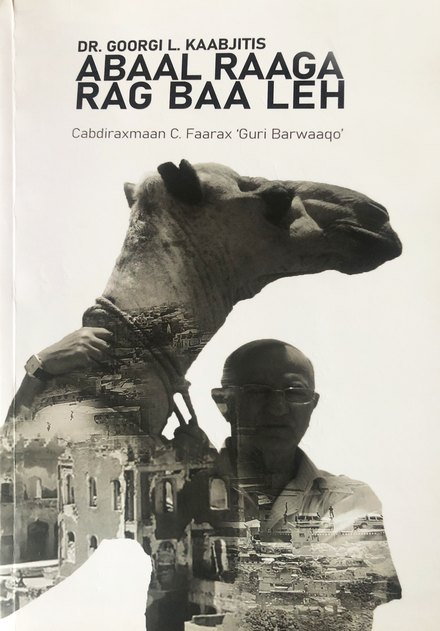
Abaal Raaga Rag Baa Leh by Cabdiraxmaan C. Faarax ‘Guri Barwaaqo’ (Hiil Press) — a collection of articles, interviews and appraisals of Kapchits’s contribution to Somali studies, presented to him by Somali colleagues. The author died on 3 March 2023; Kapchits’s obituary for him is in the project archive.
In March 2024 WardheerNews awarded Kapchits a certificate as Best Foreign Speaker — Expert in Somali Language (signed by Dr. Adan Makina, editor and head of the reviews and interviews section).
A dedication from Wolfgang Mieder
Wolfgang Mieder — professor at the University of Vermont and the field’s leading paremiologist — dedicated to Kapchits his annual International Bibliography of New and Reprinted Proverb Collections, which carries the line “For Georgi Kapchits” above the opening paragraph. The copy in the archive is the instalment the author labels as Proverbium 2018; the volume number is not printed on it.
See also: Articles, Monographs.